Singapore education system: a parent guide for 2026
Singapore's school system looks complicated from the outside: PSLE scores, posting groups, G1 to G3, new certificates in 2027. It is easier once you see it as one path with a few decision points. This guide walks the path in order, says what matters at each stage and what you can safely ignore. Rules change, so confirm anything that affects your child with MOE and SEAB.
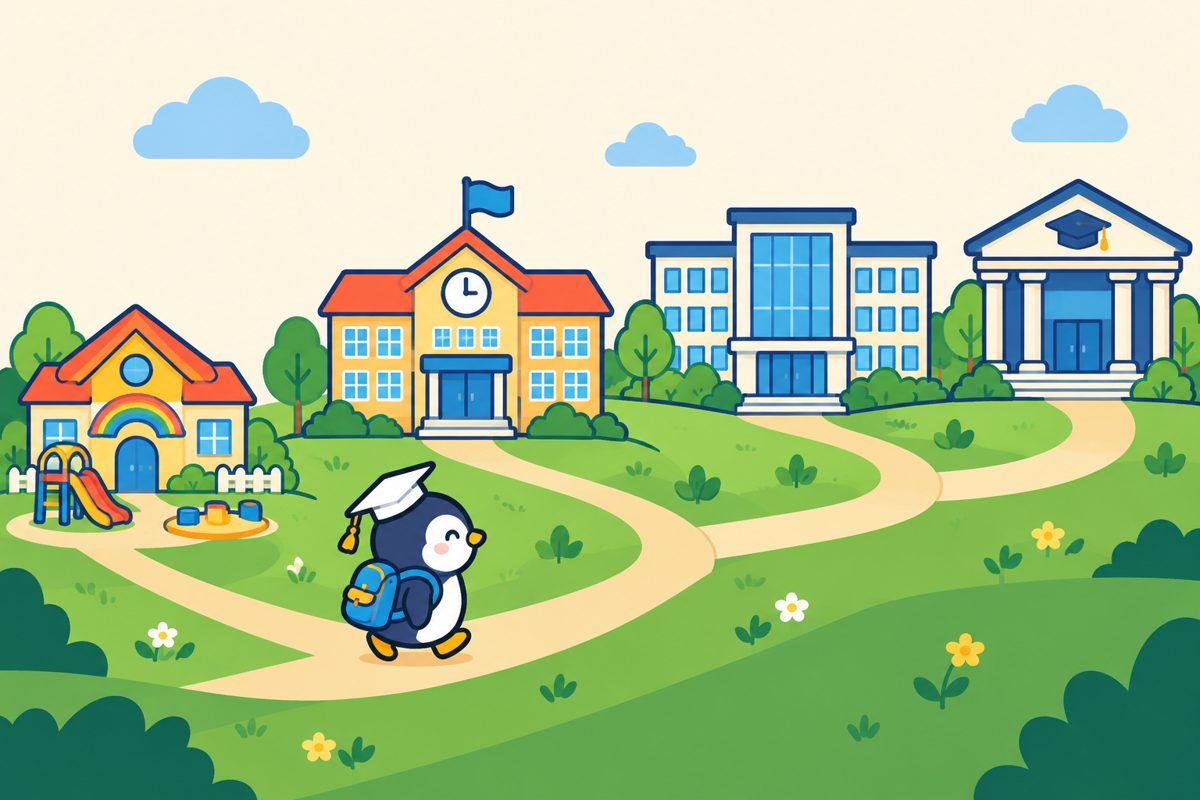
- Preschool (optional) at ages 3 to 6, then Primary 1 in the year your child turns seven.
- Six years of primary school. The first national exam is the PSLE in P6.
- PSLE results place your child in a posting group for secondary school. Since 2024 they take each subject at G1, G2 or G3, not a fixed stream.
- Four to five years of secondary school, then a national exam (a new certificate called SEC from 2027).
- Then junior college, Millennia Institute, polytechnic or ITE.
The four stages at a glance
| Stage | Ages | Length | What parents decide |
|---|---|---|---|
| Preschool | 3 to 6 | Varies | Childcare or kindergarten, and how much to prepare for P1 |
| Primary | 7 to 12 | 6 years | School choice at P1, then support habits |
| Secondary | 13 to 16 or 17 | 4 to 5 years | Which 6 schools to list after PSLE, subject choices at Sec 3 |
| Post-secondary | 17 and up | 2 to 3 years | JC, MI, polytechnic or ITE |
Before Primary 1: preschool and registration
Preschool is not compulsory. Children may attend a childcare centre or a kindergarten, including MOE kindergartens for K1 (age 5) and K2 (age 6). Primary school starts in the year your child turns seven.
P1 registration for citizens and PRs runs in several phases (1, 2A, 2B, 2C and 2C Supplementary). Which phase suits you depends on ties to the school, such as a sibling or parent volunteer, and on distance from home. Places are limited, so read the current-year timeline on the MOE website early.
What actually helps a child at this stage: talking, reading together, counting in daily life, and being able to sit, listen and look after their own things. You do not need worksheets at age 5. Keep it playful.

Primary school: P1 to P6
Core subjects are English, Maths, Mother Tongue and Science (from P3), plus Art, Music, Social Studies and PE. Think of it in three blocks:
- P1 and P2: foundations. Reading, writing, number sense. There are no formal exams, so the aim is confidence and habits.
- P3 and P4: widening out. Science begins and school tests start to count. This is the best time to fix weak topics, because the gaps are still small.
- P5 and P6: PSLE preparation. From P5, eligible pupils can take some subjects at Standard or Foundation level.
See our 6-month P6 plan when you get there.
PSLE: how the score works
PSLE results use Achievement Levels (AL1 to AL8). Your child is graded against a fixed standard, not ranked against classmates. For a standard subject the marks bands are:
| AL | 1 | 2 | 3 | 4 | 5 | 6 | 7 | 8 |
|---|---|---|---|---|---|---|---|---|
| Marks | 90 to 100 | 85 to 89 | 80 to 84 | 75 to 79 | 65 to 74 | 45 to 64 | 20 to 44 | below 20 |
Four subjects count: English, Maths, Science and Mother Tongue. Add the four ALs for a total from 4 (best) to 32. For example AL2 + AL3 + AL2 + AL4 = 11. Foundation subjects use their own scale. For more detail and ways to improve, read the PSLE AL score guide.
After the PSLE: choosing a secondary school
Since 2024, Full Subject-Based Banding has replaced the old Express, Normal (Academic) and Normal (Technical) streams. Your child's PSLE score gives a posting group, roughly:
| PSLE score | Posting group | Mainly takes |
|---|---|---|
| 4 to 20 | PG3 | G3 subjects |
| 21 and 22 | PG2 or PG3 | G2 or G3 subjects |
| 23 and 24 | PG2 | G2 subjects |
| 25 | PG1 or PG2 | G1 or G2 subjects |
| 26 to 30 | PG1 | G1 subjects (needs AL7 or better in English and Mathematics) |
G1, G2 and G3 are subject levels, and G3 is the most demanding. Students in Posting Group 3 take all subjects at G3, while those in Posting Groups 2 and 1 take most subjects at G2 and G1. Students in PG2 and PG1 who did well in English, Mathematics, Science or Mother Tongue at PSLE may take those subjects at a more demanding level. Students can take different subjects at different levels and move between levels at set points. A few scores (21, 22 and 25) can choose between two posting groups.
Posting exercise: you can list six schools. Go beyond cut-off scores: look at travel time, CCAs, school culture and your child's interests. Mix schools with different cut-offs. Posting uses the PSLE score first: pupils with better scores are considered first for places at the schools they chose, and your ranked choices matter. If pupils with the same score compete for the last place, MOE applies tie-breakers. The Direct School Admission (DSA-Sec) route lets a child apply earlier for a place based on a strength such as sport, the arts or an academic area. A child admitted through DSA-Sec cannot submit choices in the Secondary 1 posting exercise and must honour the commitment to that school.
Secondary school and national exams
Secondary lasts four or five years. From Sec 3, students pick subject combinations by interest, results and what the school offers.
Until 2026 the national exams are still the N(T)-Level, N(A)-Level and O-Level. From 2027 a single Singapore-Cambridge Secondary Education Certificate (SEC) replaces them, listing each subject and its level (G1, G2 or G3). SEAB states there is no change in the overall standards of examinations under the SEC. Which exam your child takes depends on their cohort, so check with the school.
After secondary school
| Route | Length | Leads to | Good for |
|---|---|---|---|
| Junior college (JC) | 2 years | A-Level or IB | University through an academic route |
| Millennia Institute (MI) | 3 years | A-Level | A slower-paced academic route |
| Polytechnic | Usually 3 years | Diploma | Applied, course-focused learning and internships |
| ITE | 2 to 3 years | Nitec, Higher Nitec | Technical and work-study paths |
From 2028 a new Post-Secondary Admissions Exercise (PSE) is the single online route into JC, MI, polytechnic and ITE courses for students who have sat the SEC. Under it, JC and MI admission both use the L1R4 aggregate (English plus four other subjects), with gross aggregate limits of 16 for JC and 20 for MI.

What to do at each stage
- K2 and P1: read together every day, count things, build a calm bedtime and school routine.
- P2: practise the basics a little each day. Short and often beats long and rare.
- P3 and P4: find weak topics early. A short weekly look at what your child got wrong is worth more than extra hours of tuition.
- P5: learn the question styles and how marks are given. Try full timed papers once or twice a term.
- P6: plan backwards from the PSLE and protect sleep. Start thinking about the six school choices well before results.
- Secondary: help your child choose subjects they can do well in, not only the ones that look prestigious.
Five common mistakes
- Treating the PSLE as a verdict on your child. It sets a starting point, not a final pathway, and subject levels can change.
- Choosing a school by cut-off score alone.
- Adding tuition in every subject by default instead of fixing the specific weak topics.
- Starting PSLE revision only in P6.
- Forgetting your own stress is catching. Calm parents help more than extra worksheets.
Where ALEC fits
ALEC gives primary pupils short lessons, exam-style practice and a clear weak-topic report for parents. It works alongside school, not instead of it, and it is not affiliated with MOE or SEAB. Try the 7-day trial.
Figures reflect MOE and SEAB information published for the 2026 cohort and were checked on 28 October 2026 against MOE and SEAB web pages. Future years (SEC 2027, PSE 2028) are announced plans and details may be updated. Always confirm on the official sites.
More parent guides
- Online tuition in Singapore (2026): costs, options and what actually works for primary school
- PSLE AL score explained for parents: bands, calculation and how to improve
- Cheap tuition in Singapore: 7 ways to save without hurting results
- Home tuition rates in Singapore 2026: what primary tutors charge
- How to choose an online tutor in Singapore: 10 questions to ask
- P6 timetable: a 6-month plan to PSLE
- Free and subsidised tuition in Singapore: CDAC, SINDA, Mendaki and school support
- Tuition in Singapore: the complete parent guide
Frequently asked questions
Is primary school compulsory in Singapore?
Yes, for Singapore citizens, with exemptions and special-education routes. Preschool is not compulsory.
Does the PSLE decide my child's future?
No. It gives a posting group for Secondary 1. Under Full Subject-Based Banding students can take subjects at different levels and move between levels at set points.
Do the Express and Normal streams still exist?
No. Since 2024 they have been replaced by Full Subject-Based Banding with G1, G2 and G3 subject levels.
When does the SEC replace the O-Level and N-Level?
From 2027, according to MOE and SEAB. Ask your child's school which exam applies to their cohort.
ALEC gives Singapore primary kids short lessons, exam-style practice and a clear report for parents.
Join the waitlist
ALEC is an independent practice platform and is not affiliated with MOE or SEAB. Prices and figures quoted from other sources are indicative and change often. Check the source before you decide.